Friday, 18 August 2017

Welcome to my Friday Feature! 

Miriam Drori
Today, I'm delighted to welcome a return guest, Miriam Drori, a lovely lady I've met many times both 'in the flesh' and virtually during the last few years. Miriam's a fellow Crooked Cat Books author who has visited this blog a number of times promoting her fiction titles but today she comes with information on a new venture, one fits into the newest category of non-fiction from Crooked Cat Books. 

Social Anxiety Revealed by Miriam Drori will be published very soon on the 22nd August 2017.

I'm very interested in the topic of Miriam's latest book because I believe that Social Anxiety can affect pretty well all of us at some time in our lives. Not all people experience it the same way, and it has more lasting and lingering effects on some more than others.

I'm very keen to have a read of what I know will be a very well polished book and Social Anxiety Revealed by Miriam Drori will be one of the books on my kindle that I hope to read during my coming holidays. I've already Pre-Ordered my copy from Amazon and all I have to wish for now is that I get sufficient access to the internet on my cruise holiday to download it onto my tablet! 

Welcome again to my blog, Miriam. What a great image for your latest book, it really captures the essence of your topic. Thanks for sharing with us your non-fiction journey...


That Question Again

“I’m an author,” I might begin. “I’ve had two books published so far and one more will be released very soon.”

“Oh really,” they’ll say with some surprise, because I didn’t give the impression I’m clever enough to write a book, let alone have it published. “What are your books about?”

“The first is a romance set in Jerusalem. The second is a novella written with another author; it’s the first of a series, based on a painting by Klimt. The third is non-fiction and it’s about social anxiety.”

Eyebrows are raised again. Then they’ll ask that question: “What’s social anxiety?”

And I want to shout at them, “How can you ask such a question? Social anxiety is the most common anxiety disorder there is. It’s the third most common mental health issue. About 12% of people will suffer from it at some time in their lives. And you ask what it is! You wouldn’t ask what depression is!”

But I don’t shout at them and I know I’d be wrong to shout. Because social anxiety, despite being very common, is hardly known about. Most people don’t even know the term and even fewer understand anything about it.

That’s why I’ve been so keen to publish this book: Social Anxiety Revealed, and why I’m delighted that it’s happening now (August 22). It’s a book I first wrote in 2004 and have recently updated. I began it when I became passionate about raising awareness of social anxiety. The reasons for that passion will appear in a different post on someone else’s blog.

The book isn’t just my story. It contains quotes from many other people with first-hand experience of social anxiety. It shows similarities and differences amongst those experiences, because people with social anxiety come from different places and have led different lives. And it contains humour, because humour provides a relief to the tension. And because even those who suffer from social anxiety can see the funny side of its illogicality. It is a fact that several stand-up comedians have or had social anxiety.
***
Miriam Drori can be found all over the Internet, including:

Social Anxiety Revealed will be available from Amazon from August 22 in paperback and ebook formats.

You can Pre-order Social Anxiety Revealed from Amazon HERE. 

Thank you for coming today, Miriam. Best wishes for a fantastic launch next Tuesday (22nd August) and for great sales of Social Anxiety Revealed. 

Slainthe! 

Thursday, 10 August 2017

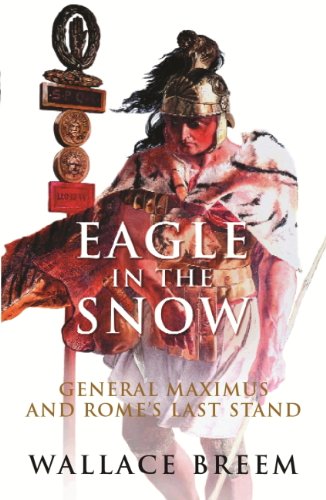
A classic 'Ancient Roman' bestseller - Eagle in the Snow

Thursday top up...

This is about a recent read that took me a while since leisure reading time has been seriously curtailed over the last week. 

Eagle in the Snow: The Classic Bestseller by [Breem, Wallace]

I can see why this book, written around the 1980s, set a trend for later Roman military history authors. I didn’t find it read as easily as some other Roman legionary battles’ novels that I’ve read recently but the style was similar in that it told the tale via one main protagonist, in this case General Maximus. In parts the tale seemed longer than it needed to be but there was certainly plenty of enjoyable action in other places. Though fiction, I think it’s still a good read for getting a general gist of Roman military life both in settled peaceful times, as in northern Britannia, and in the horrors of engagement on the frontier in Gaul. (I confess to not seeing much in the novel that would have led to the script for a very famous film.) 

I'm not sure the addition of his cousin Julian/ friend of his youth was dealt with adequately. I can believe that some jealousy might have occurred between two youths when one got all the family 'rewards' and the other got less but as Julian pops in and out of the plot it seems irrelevant to the main storyline. 

Having read yet another piece of fiction set loosely around some factual Ancient Roman military details I'm glad I have personally chosen to write my novels predominantly from the Celtic perspective. That said, something like 'Eagle in the Snow' gives me some ideas for the creation of the roman characters who do appear as minor characters in my Celtic Fervour Series.

I'm sure that this novel will appeal to those who love a good tale that's brimful of Roman military details. 

Slainthe!  

Wednesday, 2 August 2017

Travel weary Celtic gods and goddesses

Wednesday Wishes to you! (it's late GMT time but still Wednesday)

My summer surprise today is a whole gamut of questions for you to help me with.

How well travelled were the ancient Celtic gods and goddesses?

This is very much a possibly and probably post!

In my current writing set in A.D. 84, I have a number of *Celtic characters who are working towards a common goal even though their origins are from different areas of what we currently geographically term Great Britain. This means I have to work hard to discover which gods and goddesses might be appropriate for them to pray to since it seems that, in the Celtic culture, belief in their deities was likely to have been strong. Since I strive for historical accuracy whenever possible it means a bit more research to see if I can find any references I can happily use for my protagonists in Books 4 of my Celtic Fervour series.  

My Enya via www.123rf.com

My main female character in Book 4 is Enya, a young warrior who was born at the hillfort of Garrigill in northern Brigantia (present day northern Yorkshire). Enya’s young life has been peppered with strife brought about initially by the invasion of the Roman armies of Quintus Petillius Cerialis, Roman Governor of Britannia in A.D. 71. In Book 2 of my series, when Enya is around the age of nine, she’s towed along when her family flee from Brigantia and head to her Aunt Nara’s homeland, Selgovae territory (southern Scotland), which lies north of Brigantia. In Book 3 she’s again on the move as her family move further north to the lands of the Taexali and the Caledons (north-east Scotland) to challenge the domination of General Agricola’s armies. By A.D. 84 (Book 3) she’s one of the young warriors involved in the confrontation that takes place between the armies of General Gnaeus Julius Agricola at Beinn na Ciche. (My version and location for the potential Mons Graupius battle)

Book 4 begins in late AD 84 in Caledon territory (north-east Scotland) and I have to surmise from scant historical evidence that although the peoples of northern Britannia were diverse tribal groups they most likely shared a common language—some form of Common Brythonic—and probably many of their religious beliefs were broadly similar. However, some historic references and archaeological finds seem to point to localised differences in the worship of deities. (e.g. My FutureLearn studies on Hadrian’s Wall makes mention of deities only ever mentioned in this geographical area on ‘tombstone’/monument evidence, though admittedly these remains post date my A.D. 84 period)

What language/s the tribes of north-east Scotland spoke in A.D. 84 isn’t known but from etymology studies it’s thought that some three hundred years later the Picts of the area were likely to have used a P-Celtic Brythonic based language. This form of Celtic is believed to have derived from the original Common Brythonic language which came with people who probably migrated from Europe. The Pictish language is grouped as a Brythonic language along with Welsh, Cornish and Breton and the extinct Cumbric language. For me that link with the language of Cumbria is an interesting one because my fictitious hillfort of Garrigill, Enya’s birthplace, is not so far from Cumbria.  

Back to my search for which gods and goddesses I might use and it seems feasible that I could use some of the god names of Welsh derivation and of Cornish, Breton and Cumbric. Searching for gods and goddesses of Celtic Scotland draws many blanks and few hits but there are more for the Welsh tradition. I have yet to investigate any Breton and Cumbric ones. I have to decide if it’s reasonable to assume that the god names may not have changed all that much from the earliest known Welsh use and before any Latin influences brought by the Ancient Roman usurpers changed some things. Hmmm…

It’s very tempting to use some of the gods and goddesses that are handed down via the Irish, Scottish and Manx traditions but they are grouped as the Q-Celtic Goidelic form of the Common Brythonic language. Here lies one of my big questions—if the language evolved differently in those areas from the Common Brythonic was that only after the Roman invasions?  Were the god and goddess names across Britain and Ireland the same pre- Roman influence and only changed some time after?

I’d love an expert to tell me the answers.

Till I find out otherwise, I’m using a mix of those thought to be the most common gods/goddesses across Europe and some nicely sounding local ones.

The older generations of my Garrigill clan in Books 1-3 have specific favoured gods and goddesses but Enya has not got to a point yet where she has her own favourites. I’ve no doubt that there would have been some powerful influences from parents back then and I’m making the assumption that adoption of personal deities was probably done before the onset of adulthood. (I’m not sure that any particular reference exists which states that everyone had to have chosen their gods etc by puberty-though again,  if anyone knows, please share!). At the beginning of Book 4 Enya’s feeling a bit let down by all of the deities and her faith in any of them is fragile. Will the events of Book 4 make that insecure faith totally crumble… or not? 

Nith- via www.123rf.com
Another of my main characters is Nith. He’s a Selgovae and a distant relative of Enya’s aunt. Nith has not lost faith but has chosen to rely on his own guidance rather than the gods who let down his brother and allowed Esk to perish during the confrontation with the Legions of General Agricola at Beinn na Ciche (Book 3). Does Nith turn more to his gods as the book progresses? I definitely think so because he has a couple of agendas to solve…

Then there’s my young Taexali warrior named Feargus who journeys along with Enya and Nith. Are Feargus’ local gods and goddesses the same names as Enya’s or Nith’s? I don’t think so though some of his local deities will have similar functions to some of theirs. My thinking is that a good geographical distance separates the birth places of all three of the above. Feargus’ Taexali territory lies around 200 miles from where Nith was brought up and probably 300+ miles from Garrigill, Enya’s birthplace. Feargus has some well chosen names for his local goddesses which he definitely adheres to with a deep conviction.

(Note to self: I must get a working image for Feargus)

Agricola-
Wikimedia Commons
Another main character who needs his own pantheon of gods to pray to is General Gnaeus Julius Agricola, Governor of Britannia in AD 84 and Commander of all Britannic Legions, including those of the Classis Britannica. His Roman gods and goddesses might have some similarities to some of those of my Celtic clan members worship but my Agricola needs plenty of Roman deities to entreat to aid his decision making. Finding names for Agricola’s gods/ goddesses is proving easier than those of my Celts. Though having said that Agricola was born and raised in a region of Gaul called Gallia Narbonensis ( Frejus, France) and may well have been aware of some of the local Celtic gods and goddesses since his forebears were Romanised Gauls of local origin.   

Which gods might I be using for Agricola?  And which for my other main Celtic characters? That’ll be my next instalment. Watch this space…

*I use the term Celtic fairly broadly because I have no better name for the late Iron Age peoples who inhabited the island the Romans named Britannia by A.D. 71.


Slainthe!