Saturday, 27 May 2017

Fit's a broch aboot?

Happy Saturday wishes to you! 

The sun is shining for the third day in a row and it's nice and warm which for the north east of Scotland is pretty exciting. (it's not seriously hot, mind but at c.18 Deg C it's comfy) It makes me want to be at home lazing about and trying to write outside, battling the inevitable screen glare issue rather than being elsewhere. It makes me really appreciate having a home and garden to step into. 

For these reasons, I'm re-blogging a post that I created for my slot last Wednesday (24th May) for the Writing Wranglers and Warriors blog. It is particularly apt. I think, since it's about ancient homes that were typical in Scotland some thousands of years ago. Mostly though the post is about a special kind of building that's almost exclusively found in Scotland. Yes, there are some examples in Ireland and in England but BROCHS are predominantly a Scottish ruin. 

The title of this post is in my best Doric, the dialect of the north east of Scotland and translated means 'What is a broch about'? Was it a home? Or was it built for defence? Or did it serve another purpose?  


Home Sweet Home…or was it?

You’ll find a multitude of sayings about ‘home’ on the internet. These few are particularly useful for my topic today.

Home is where the heart is.  Pliny the Elder
He is happiest, be he king or peasant, who finds peace in his home. Johann Wolfgang von Goethe
A man's home is his castle. Proverb

Skara Brae 1986
We all know of the huge variety of domiciles that we could call home, nowadays, but an assortment of architectural house styles wasn’t always the norm.

As a hobby historian, I’m quite fascinated by the earliest types of habitation and the effort it took to create them. Admittedly, I’m more familiar with the most primitive dwellings in my homeland area of Scotland than those in other parts of the globe.

I’ve crawled into a reconstruction of a hunter gatherer’s hide, a very primitive covering made from sewn-together skins, but that’s not quite the same as walking your way around someone’s home that’s connected to others, making them into a tiny communal hamlet. 
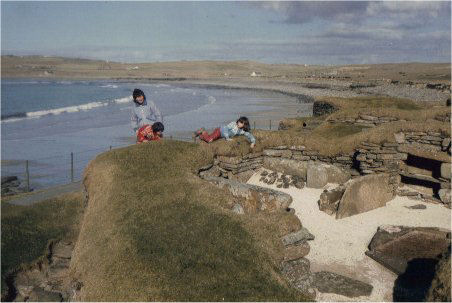
Skara Brae 1986
Probably the earliest type of collective living I’ve wandered around were the homes of ‘Stone Age’ Neolithic people on the island of Orkney at Skara Brae. What remains of these stone dwellings is totally remarkable, though only because they lay under sand dunes for millennia before the wind and waves uncovered them in the mid 19th century.


At Skara Brae we can envisage a day in the life of the people. The delineated areas of the homes (minus original roofs) are easily visible as in a ‘bird’s eye view’. Their cupboards are built into the wall, the fireplace is central and their sleeping cots are blocked off with large slabs. There is even a built-in channel that is essentially primitive drainage, as in for toilet use: functional but effective buildings.

Ring of Brodgar
Were the Skara Brae houses fortified in any way? It doesn’t seem the case but there are some new theories going around (resulting from recent excavation) that the nearby timber/standing stone circles in the Orkney Isles may have had a community aspect to their construction. 

It’s now believed by some current archaeologists that the earliest of these stone henges pre-date that of Stonehenge in England and that the culture of building such henges may have travelled southwards, rather than northwards. Regardless of the direction of architectural influence, the massive wooden and stone circles were most likely built for religious observance and of people to congregate for positive reasons without the need for defence from outside entities, as in human raiders. In the Orkneys some archaeologists now think there was a religious community living alongside the henge monument.

 This recent BBC programme covers the issues-albeit a little dramatically and some critics might say fancifully. http://www.bbc.co.uk/programmes/b08819tl

Celtic Roundhouse Wikimedia Commons
Skip forward a couple of thousand years and sail south to mainland Scotland. Archaeologists have to work much harder to find evidence of Neolithic, Bronze and Iron Age ‘Home Sweet Home’. Mainly because wooden constructions last a lot less than those that were stone built.

The Bronze Age and Iron Age tribes seemed to have mainly lived in hut circles, some with stone foundations (probably where wood was less available) and the bulk in wooden ‘Celtic’ roundhouses. There’s sufficient evidence around Scotland for some variety in shape - some were oval though most were circular.  Some individual roundhouse dwellings have been found but it was more common for them to have been erected in a small cluster situated near strip- field farms.


Crannog 
Crannog dwellings built on wooden platforms are a fine example of Bronze and Iron Age living. By the time crannogs were erected out over the water of inland lochs they were probably fortifying themselves mainly from marauding wild animals rather then marauding tribesmen. However, along with the Bronze Age and Iron Age technology—effective weaponry in particular—there came a greater need for tribespeople to defend themselves.

I’m currently very interested in a type of dwelling that’s almost exclusively found in Scotland – the Broch. But was it Home Sweet Home or not?

Dun Carloway - Wikimedia Commons
Broch building is very difficult to define. Until recently not enough time or effort was given to investigating this unique style of building. Broch remains are found in southern Scotland but the bulk are to be found in northern Scotland, the Western Isles, Orkney and Shetland.

So how does a Broch differ from a Celtic roundhouse, or from a crannog?

A Broch is a massive drystone built hollow-walled tower. Some of these towers were thought to have been as high as 50 feet with walls of around 4 feet thick- like the Broch of Mousa in Shetland. Staircases wind their way up the hollow wall structure to give access to upper levels and some of the evidence shows there could have been multiple platforms, circular balconies or partial floors, inside a broch.
 
Interior staircase Dun Carloway- Wikimedia Commons
Many brochs are thought to be from the Neolithic period but intriguingly others situated towards the south of Scotland have been dated to 1st century AD, during the Roman occupation.

Brochs have no windows and only one low entrance way so the interior would have been extremely dark. How damp they were inside, I don’t even want to imagine! What the roofs were constructed of is a matter of interpretation: possibly thatched like roundhouses. A corbelled stone roof is thought to be less likely, though that would have been a remarkable feat of engineering and the technique not unknown because Neolithic people used it in structures like the Maes Howe chambered cairn on Orkney.

Mousa, Shetland Isles - Wikimedia Commons
Earliest archaeological thinking was that Brochs were built as a defensive structure but that’s hard to believe since there were no windows to give access for repelling invaders. 

Some experts then thought they were built more as a status symbol by the local chief to show his superiority in the region. The broch at Mousa, Shetland is certainly impressive enough for that!

However, some recent archaeologists aren’t ruling out the idea that people maybe ‘holed up’ in them like in a self-sufficient ‘siege’ when invaders threatened the area, and that they normally lived outwith the broch in some other form of dwelling house. I’m not sure I’d want to be inside one for months on end.

The theories are all fascinating conjecture!

I’ve been following a Facebook page named the Caithness Broch Project which has an aim of properly identifying the multitude of Brochs that litter Caithness. They also intend to build a replica Broch to satisfy the curiosity of tourists like me. I’m eagerly waiting for that to be built so that I can pop up and visit it though that’s likely to mean a 400 mile round trip for me.

 What's your favourite ‘Home Sweet Home’?


Whatever you do today- enjoy! I'm doing more new writing and some gardening. See you later...

Slainthe!

Friday, 26 May 2017

Friday! Books read #5

It's Friday already and I've some more catch up today of books read and reviewed in April and May. 

Today's feature is The Other Side of Dusk, another novel set in Britannia, this time on the west coast of what we now know of as Scotland. The date of the story is not specified but the story features Roman soldiers, people of Scotti origin and Picts. This mixture of peoples makes it difficult to pinpoint a decade, or even a century, and introduces a certain element of creative history according to the known archaeological and historical records, as I know them. But as fiction it's an interesting blend of cultures, legacies ... and characters.

To give a flavour of what it may have been like to be living in Roman occupied territory in northern Britannia, using the known record, is an extremely difficult task for any author. In The Other side of Dusk I'm finding it very intriguing to try to match the known historical timeline that I've learned with the author's visionary fictionalised timeline!

I'm deliberately giving my thoughts on the novel first in this post...and then afterwards the multitude of questions the story has raised for me regarding the known and attested historical timeline and how an author can use parts of it for their own purposes.

BLURB: NOTE: May contain triggers. A boy sold as a slave is used by a Roman woman to get pregnant so the master may have an heir. But it all backfires when an old soldier who serves her household takes pity on the boy. He teaches him to fight and when the child is born, helps the slave escape with his son. He is home but...his people aren't sure he is fit to take his father's place when the time comes. The Picts are ready to revolt against Roman rule and the Scotti may be caught in the middle. To make matters worse, the master is seeking his stolen son.


This is my short 'no spoiler' review...

The Other Side of Dusk by Cherime MacFarlane 

I really enjoyed the story of Ualan and was intrigued by the author’s interpretation of what the situation might have been like towards the end of the Roman occupation of Britannia when the Scotti tribes were probably vying for supremacy over the Picts on the west coast of Scotland. It's a very intriguing historical era that I love to research, and to read about, though there’s actually very little written for an author to dip into to create fiction. Cherime MacFarlane has added some beautifully evocative description of the landscape which I can relate to very much since I know the west coast of Scotland very well, though admittedly I can only surmise it wasn’t too different during the time she writes about. I really like the choices of Gaelic names since their meaning can add more depth to a character, though I’ll not spoil the story for a new reader by giving particular examples. The story of Ualan’s capture and slavery is slowly revealed as the tale progresses, having been tantalisingly introduced at the outset of the story. The intermingling of Picti and Scotti tribes (and even rivalry) after the withdrawal of the Roman influence must have created some difficult times for families who essentially just wanted their own territory to farm and tend. 


...And these are the questions, and information, that came to mind as I read the novel, all of which made me want to delve back into what I've already learned of the Roman occupation of Britannia. 

Romans
A 'turf wall' is mentioned in the story. If it alludes to The Antonine Wall, that wall was constructed c. A.D. 142. It's likely from historical evidence that the forts along the Antonine Wall were manned for a couple of decades till around A.D. 165 after which the forces were documented as having been withdrawn south to Hadrian's Wall when the Romans redrew the western frontier limes of the Roman Empire. Normal Roman practice on withdrawal from the forts was to set fire to and lay ruin to the wooden buildings so that the local tribes could find nothing useful to use from them. After the withdrawal of troops from the Antonine Wall, according to experts and the archaeological record as presently known, there would have been no further Roman presence. However, the turf wall remained as a huge 'Roman' statement for the local populace for many, many centuries.

By the early A.D. 200s (some 35 years later) there may have been renewed Roman presence at some parts of the Antonine Wall in preparation for the campaigns of the Emperor Severus, though the evidence is for that to have occurred at the eastern end. According to written accounts, c. A.D. 208, Severus marched northwards from Eboracum (York) with 50 thousand troops to 'teach the tribes of the north a lesson'. The Caledonians had been unruly and had not kept to treaties for some time -of course, this is the account seen from the Roman perspective  By c. A.D. 210 Severus seems to have been campaigning in what we now call 'Aberdeenshire' though his forces seem to have been reduced to around 30,000. What decimated them is not clear- were there huge casualties as a result of local tribal attacks? Or were some of the troops sent to other parts of the empire? Or was a deadly sickness a factor? By A.D. 210, Severus was a very sick old man who appeared to have gout or some really debilitating health condition. He is documented as going south to Eboracum where he died in February A.D. 211.

From the perspective of the actual historically known timeline, and till more archaeological evidence is uncovered, it seems Severus kept his line of march up and down the eastern side of Scotland. 

Around A.D. 210, Britannia was split into 2 provinces, the northern part being named Britannia Inferior (Lower Britain). This delineation made either by Severus (or his son Caracalla who became the new emperor) meant a reduction and withdrawal of troops from the north, yet again. Both Caracalla and his younger brother Geta abandoned their campaigns to subdue the Caledonians of the north and they went back to Rome. Whether the recently refurbished or renewed Antonine Wall forts (i.e. Crammond near Edinburgh) remained manned with even the most basic legionary presence is to be proven. It's likely though that civilian use of the fort surroundings went on for decades, even centuries- though use of buildings would only have taken place if they had not been deliberately burned by the departing Romans.

In The Other Side of Dusk the author mentions a Roman Cohort- the Cohort Delmatarum. The Cohors II Delmatarum (an auxiliary regiment from Dalmatia on the Adriatic) appears on record on an undated altarstone that's thought to date from the early 3rd Century.  It was found near Carvorum by Hadrian's Wall. The Roman military influence lasted nearly 300 years at Hadrian;s Wall though the civilain use of forts along the wall continued for some time after the withdrawal around A.D 400. (Coins minted A.D. 403/406 were found at Birdoswald fort) 

Pictii and Scottii
Skip to around A.D. 250. The Scotti tribes (possible origin Iberia) are thought to have invaded the west coast of Scotland and what is now northern Ireland.

It isn't till c. A.D. 295 that the first references to a people named the Picts is recorded, those tribes likely to have come from the north and north-east of Scotland  However, the use of the work 'Pict' to describe the Late Iron Age/ Dark Ages tribes of Scotland is often confusing. (Julius Caesar c. 55 B.C. mentioned 'painted people' though I don't believe they were officially named by the Ancient Romans as  'Pictii' at this point in history.)

The term 'Picts' is often as confusing as the use of Celts to describe the cultural lifestyles of the Later Iron age tribes of Britain and Continental Europe. As an author, I personally needed to use a generic term for my characters and decided that 'Celtic' was the most descriptive. In the same way some authors use the term 'Picts'.

Some historians thought that 'Pictii' were themselves an invader people to north-east Scotland but more and more it is appearing that 'Picts' was just a contemporary term for the grouping of indigenous Late Iron Age tribes by A.D. 295. It's a reasonable enough theory that the descendants of those who survived the brutal occupation of Emperor Severus around A.D.210 would have banded together over a broader area and renamed themselves 'Picts'. This is especially relevant in the context of the adoption of the new religion of Christianity which brought its own symbolism and practices.

I'm off now to write my own version of what happened in the aftermath of the Battle of Mons Graupius because there is nothing available;e to me to know what General Agricola actually did in north-east Scotland in A.D. 84!

Slainthe! 

Wednesday, 24 May 2017

Wednesday Summer Surprises #2

Welcome to my Wednesday feature - Summer Surprises! 

Today, I'm featuring two books I've recently read by Tim Walker- Abandoned and Ambrosius.

The period of the novels is the aftermath of the withdrawal of the Ancient Roman Armies in Britannia. According to the few records available, the 'official' end came around AD 410 when the last of the Roman soldiers of the garrisons in Britannia were recalled back to Rome by the (Western) Emperor Honorius.

Honorius  - Emperor at the age of 8
Wikimedia Commons
In AD 210, the Emperor Honorius was around 26 years of age and had been ruler of the Western Roman Empire since his father's (Theodosius I) death in AD 395, the Eastern Empire being ruled by his brother Arcadius. During this time there were many tribal conflicts across Honorius' western part of the empire and Rome itself was sacked by Alaric of the Visigoths.

By AD 210, the Roman Empire was in disarray and the remote garrisons of Britannia were told to get out/or look after themselves because Rome would provide no more support.

In reality, any legions who fled Britannia were probably deployed elsewhere across the Empire when they quit the shores of Britain- their destinations depending on the allegiances made with other rival Legionary commanders - and never ever set foot in Rome itself.

For me, the interest lies in those who were left to prop up a broken down society. Who continued to live in those garrison forts when the bulk of the armies of Rome left? Were the buildings, by then, already in a sorry state and just left to tumble into ruination because the Roman Empire had been under funding those garrisoned in Britannia for decades?

What was the situation of retired soldiers who had taken up the offer of land as part of their remuneration settlements- were they content to remain and continue their Roman way of life as much as they could? (given that they may have married local 'Celtic' woman and had families) Did these old veterans feel trapped into remaining on their property in Britannia when they would rather have removed themselves along with their fellow soldiers?

Were the patriarchs of the new generations of romanised Britons, formed from marriages or relationships with locals during the centuries of Roman occupation, well accustomed to their 'hybrid' status and content to create new dynasties with mixed religious beliefs and customs?

How much influence did the new versions of Christianity play in the lives of those left living around the abandoned fortresses and forts?

I have many questions but little is written about these times. 

In late 2016, I was delighted to find that my OpenLearn 'Hadrian's Wall' course dealt a little with this turbulent period. I'm also pleased to read the interpretations of authors who write fiction set in these times because their visions often differ from the most recent archaeological, and historical, interpretations. Sometimes the fiction writer's vision is added to by dipping into the legends that probably sprang up at the time, the oral traditions just as clouded in interpretative controversy but which can add colour and intrigue!

In my own historical writing, I try to interpret according to the archaeological and historical record and have, so far, tended to shy clear of the legacy of the legend -  but that doesn't mean I don't enjoy reading a version that merges the fantasy and the history.

It's for these reasons that I'm featuring Tim Walker's writing on this Wednesday Summer Surprises slot. Here are my reasons why I really enjoyed reading the following books...


Britannia lies shocked and exposed by the sudden departure of the Roman legions in the year 410. A hero arises - Marcus Aquilius - to protect the town of Calleva from an invading Saxon army. The townsfolk must decide if their town and way of life is worth fighting for, or if they should flee to the forest and revert to a tribal lifestyle. Marcus knows he must embrace change and makes his own personal journey to emerge as Marcus Pendragon.

Abandoned (Light in the Dark Ages Book 1) by Tim Walker 4*

This was an interesting interpretation of what might have happened in the aftermath of the Roman occupation of Britannia. I love novels set in the era and looked forward to reading this one. I’m sure there would have been some chaos and a lot of societal breakdown after the structure, and strictures, of Roman rule broke down. I can easily imagine scenes where the inhabitants of what would have been a well run fortress were in a state of limbo after the withdrawal of the Roman troops. After some 300 years of Roman rule, those who regarded themselves as natives (non-military) were probably very well integrated with the Roman way of life, especially with the fortress being in southern Britannia. However, the question of how quickly those locals shed off any Romanisation and reverted back to their Celtic inheritance is one that might never be resolved.  The lack of Roman routine in ‘Abandoned’ opens the doors for new invaders and those settler survivors really needed a strong leader like Marcus Aquilius to marshal them into as credible a fighting force as possible. 


Britannia lies open to barbarian invasions as it slowly adjusts to life after Roman rule. Cruel high king Vortigern has seized control and chosen to employ Saxons in his mercenary army. But who is the master and who the puppet?

Enter Ambrosius Aurelianus, a Roman tribune on a secret mission to Britannia. He is returning to the land where, as a child, he witnessed the murder of his noble father and grew up under the watchful eyes of an adoptive family in the town of Calleva Atrebatum. He is thrown into the politics of the time, as tribal chiefs eye each other with suspicion whilst kept at heel by the high king.

Ambrosius finds that the influence of Rome is fast becoming a distant memory, as Britannia reverts to its Celtic tribal roots. He joins forces with his adoptive brother, Uther Pendragon, and they are guided by their shrewd father, Marcus, as he senses his destiny is to lead the Britons to a more secure future.

Ambrosius: Last of the Romans is an historical fiction novel set in the early Dark Ages, a time of myths and legends that builds to the greatest legend of all – King Arthur and his knights.


Ambrosius: Last of the Romans – by Tim Walker 4*

I really look forward to reading novels set in Roman Britain, the era being of particular interest to me. It’s such a hard period to research, there being very little written evidence available for the author to use as authentic background so I think the author has written an engrossing tale which blends some known historical and archaeological evidence with the fantasy of the oral tradition handed down to us in the form of legends. Just as the historians and archaeologists put forward their interpretation of evidence, Tim Walker has created a credible cast of characters with very human traits to fit the turbulent times that came after the withdrawal of the Roman Armies a little short of 400 A.D.

My best wishes to Tim Walker for great sales of the above and thank you for allowing me to feature them today. 

I'll be back soon with more of my recently read novels.

Slainthe!