Friday, 12 April 2013

K is for Kit


 K is for Kit

My A-Z theme is Celtic/ Roman Britain AD 71-84 -  which just happens to match the era of my historical novels. 

 (All the images used have been acquired from Wikimedia Commons.)
 
wikimedia


The armour and uniform of the Imperial Roman Army was worn according to rank and type of regiment/legion and varied quite considerably. To include all types would be a very long blog post, so I’m only mentioning a few aspects.

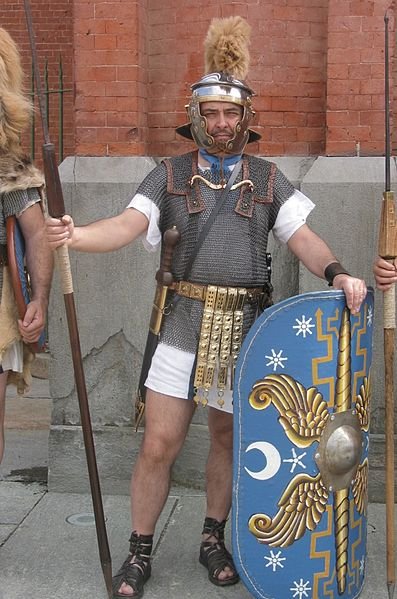
If you were a swanky legionary you might have been kitted out something like this - 

The type of helmet shown at right (steel or silver plated with copper or brass trim) wasn't the most common helmet and keeping such a helmet in tip top condition must have been a pin in the **** (substitute whichever word you like here).

 galea

Galea Helmet. The galea was the most common helmet, and was generally made of bronze with an iron embellishment. The neck was shielded by a projecting trim. Large cheek pieces were hinged to the top to protect the ears and sides of the head.


Depending on your rank/ status/ regiment your helmet might also be of the following types:

Coolus - Gallic worn by the Tungri regiments


The Coolus type of helmet was descended from helmets worn by Celtic tribes (Yet another acquisition by the Roman Army).


If you were in a cavalry regiment you might have worn the one below which was close fitting to the skull, but also included cheek flaps.

Roman Cavalry Helmet


The centurion was quite distinguishable by the transverse feathers on top. 
Centurion helmet


Balteus or Cingulum Militare  was the regulation belt, decorated with bronze strips and tin-plating, all the way around.

Tunica A basic tunic was worn over linen undergarments.

Bracae Legionaries in cold climates were allowed to wear wool or leather skin tight trousers that reached just below the knee.


Focale Scarves were worn around the neck to keep the metal of their armour from scraping their necks.

wikimedia
Sporran The sporran was a short apron. This was made from a number of leather thongs overlaid with metal rivets; bronze giving it a weighting facility. Decorative? Maybe. Protection for the genitals? Probably (my opinion).

Caligae These were hob-nailed sandals, tied on with leather thongs which came to half way up the shin. In cold climates these were stuffed with wool or fur. 

Pugio Of a similar width to the gladius, the short dagger was sometimes plain and sometimes decorative, and was attached to the belt on the left hand side.
Scutum was the large, curved Roman shield. Made from thin sheets of wood they were glued together, and were edge- bound with wrought iron or bronze. On the inside the centre was gouged out, a handgrip inserted was protected by metal bands. The outside surface was leather covered with gilded or silvered decoration - probably in bronze. Different colours denoted different cohorts and rendered them more recognisable during battles. The name of the soldier and his centurion were on the shield. On campaign/marching the shield was hung by a strap over the left shoulder.
Though I’m interested in their uniform I’m probably more interested in what the average infantry soldier might have carried as part of his kit.
On campaign it’s thought that the soldier carried a shovel, a saw, and a pickaxe- preparing for all eventualities. In addition their kit included a piece of rope or leather, a wicker basket and a water skin. Depending on the hostile territory they might have carried rations for many days. Buccellatum and Frumentum were their hard tack and corn rations.
Apart from the pickaxe which was carried on the belt, the items mentioned were carried on a forked pole called a pilum muralia. (Marius’ mules)
Papilio  The leather tent slept under by the contubernium of 8-10 men may have been carried (in sections?) by them, or more likely was carried (and I’m sure welcomed by the troops)  by the pack mule.
The image below, from wikipedia, details even more items.
wikimedia

http://commons.wikimedia.org/wiki/File:Legionaria_%283%29.JPG: Roman Legion Imperial Roman army Military pack 

Description of pack: 
Sarcina Military pack carried by legionaries. The pack included a number of items suspended from a furca or carrying pole. Items carried in the pack include:
  • Loculus: a leather satchel.
  • Water skin: Roman camps would typically be built near water sources, but each soldier would have to carry his water for the day's march in a waterskin.
  • Food: Each legionary would carry some of his food. Although a Roman army on the move would typically have a baggage train of mules or similar to carry supplies such as food, after the Marian reforms legionaries were required to carry about 15 days worth of basic food supplies with them. Most basic foot soldiers had to carry the food in a sarcina or pack.
  • Cooking equipment: Including a patera (mess tin), cooking pot and skewer. A patera was a broad, shallow dish used for drinking, primarily in a ritual context such as a libation.
  • Entrenching tools: Carried by legionaries to construct fortifications and dig latrines etc. Each legionary would typically carry either a shovel or dolabra (mattock) for digging, a turf cutting tool or a wicker basket for hauling earth.
  • Sudis: Stakes for construction of camps.
Marching 15 -20 miles a day (sometimes more, sometimes less) was no mean feat carrying this degree of weight over varying uneven terrain in northern Britannia.Those Roman soldiers who made it up to my part of the world (North-East Scotland) were a fit bunch of men.

In my sequel to THE BELTANE CHOICE the Roman soldiers mentioned are carrying /wearing all of the above.


But what of the Celts? Coming soon....
Slainthe!


J is for Javelin


J is for Javelin

All my posts for this A-Z Challenge Blog Hop will be themed around the Celtic/Roman Britain AD 71-84 era (at least that's my intention as I pen this on day 10)
J is for Javelin? Okay! I agree I’m cheating a bit since I’m now about to call it a pilum.

The Roman soldier used his gladius (G is for Gladius)  but he would not be engaging in battle without his pila (plural of pilum-had to look it up!).

The pilum was the typical spear carried by the Roman soldier and what a nasty, nifty weapon it was.

Around 2 metres long with a wooden shaft the iron shank was the key to success in downing the enemy. The tip was hardened but the shank wasn’t, which meant the pilum bent on impact with the enemy’s shield, or if a lucky strike the body of his Celtic enemy in Britannia. If the pilum embedded itself in the Celtic warrior’s shield it rendered it unmanageable as the pilum, still stuck fast to the leather covered wood, wobbled around. 

 http://commons.wikimedia.org/wiki/File:Pilum_light.jpg


And... oh dear...
A bent pilum wasn't much use to the enemy if picked up after use. 


http://commons.wikimedia.org/wiki/File:AMG_-_Pilum.jpg


The pila were of two types: heavy and light. When engaging with a Celtic warrior in Britannia, once the first pilum was thrown at the enemy’s front line it caused a disruption to the line formation, thus giving the Roman soldier time to thrust his shield and draw his gladius. The pilum could also be used as a thrusting weapon to create distance.

So...the Roman soldier wouldn't want to lose or use his pilum/pila too soon.

ps. I'm not entirely sure the typical Roman soldier in Britannia would be looking to wear the bear helmet...but maybe?


http://commons.wikimedia.org/wiki/File:Pilum.jpg


The pilum was a good all round weapon that enjoyed a good bit of success. That's not to say the Celts in Britannia didn't throw a spear or two of their own - they did that very well themselves.


Lorcan in my historical novel THE BELTANE CHOICE was very adept indeed at throwing his spear. Lorca of the Brigantes meets Nara of the Selgovae, rival tribes who are having a tribal spat...


Twww…aaa…nnng!

The humming of the reverberating spear blocking her passage was deafening, having missed her by a hair’s breadth. The clattering noise of a weapon dropping was surpassed by the roar of the warrior when he leapt upon her, easily subduing her struggles and cries. Her knees ground into the forest floor before he whirled her face-up, his fingers encircling her throat poised to throttle. The speed of his attack, and the dead-weight of him fully atop her, should have brought forth the blood-rage of battle, but…it did not.

From neither her, nor him.

Yet again their gazes locked and lingered. Nara panted, but not because he was stifling the breath out of her. He looked dismayed; maybe even guilty. She was not convinced which emotion he felt most, but though his hands remained in place, the tension in his fingers relaxed. His thumbs gentled the skin they had just pressed upon while he, too, fought hard for his breath, his glowing brown eyes sliding down to stare at her neck.

She was so aware of the virile scent of him and of his harsh face now squashed against her own. His voice grit against her ear. “You are not going to escape from me, Nara.”

“Your spear did not hit its mark…” Nara gasped, struggling under him to no avail, the hilts of his weapon hoard digging deep into her stomach.

“My spear hit exactly where I wanted it to. If I had wanted to fell you, I would be walking past your lifeless body right now.”


More on weapons soon...

Slainthe!


Thursday, 11 April 2013

I is for Immunis


I is for Immunis

All my posts for this A-Z Challenge Blog Hop will be themed around the Celtic/Roman Britain AD 71-84 era (at least that's my intention as I pen this on day 9)

There’s always something new to learn when I do new researching and I often think – well, that’s interesting. And there are other times when it’s more like- WOW!  Why have I not known this before?

During my recent research into the Roman military machine many things made much more sense to me about how the Romans were so successful as invaders. I always knew they were very organised, and that the Roman infantryman was skilled at more than the use of his blade and shield.

What had not been properly apparent to me was the scale of those who were named immunis. That a whole supply army was designated within a legion had somehow escaped my proper attention. Those people scurrying around in the background I had somehow equated all of them as slaves –but they weren’t slaves at all. 


 http://commons.wikimedia.org/wiki/File:Trajan%27s_Column_%28Roman_Soldiers_Building_a_Fortress%29.png?uselang=en-gb

The immune class who accompanied the legion were amazingly skilled. They could turn their blade and defend themselves if necessary against hostile armies in Britannia, but in general fighting was not their purpose, and they did not usually perform the more menial dangerous tasks of ditch building or rampart guard duties.

Before gaining immune status a legionary soldier had to serve first as a tironis (6 months as a basic recruit); followed by a number of years as a militis (regular soldier) undergoing general training, after which (or during the latter part) they would acquire specialist skills. Promotion, or selection decreeing some form of acknowledgedment of them having gained sufficient skills, took place. Immune status could then be conferred on them. Once the immune status was achieved the pay was slightly increased.

So what type of job did the 'immunis' tend to do

Engineering– building for the legion was guided by the architecti (engineer) and agrimensor (surveyor) who orchestrated the construction of fortresses, forts and marching camps-organising labour for these from the general infantrymen. They also built the road systems that allowed swift passage of personnel and goods between fortresses and forts. Bridges were built by them, and they directed mining operations. 

During the era of my novel in some southern parts of Britannia the immune Engineers may have been instigating the building of Roman villas, town walls and houses, sewage and water ways for baths and piped water systems.

Artillerymen specialised in the use of the ballista and siege machines.

http://commons.wikimedia.org/wiki/File:Ballista_%28PSF%29.png?uselang=en-gb

Versions of the ballistae were constructed on the Roman Navy vessels.
http://commons.wikimedia.org/wiki/File:Ballistae_on_roman_ship.JPG?uselang=en-gb

Drill and weapons instructors were often of the immune class
Medical staff who followed the legions were of immune status.
Carpenters who constructed the wooden interior fort buildings were skilled immunes.
Hunters Venators supplied the legion with meat from the hunt.

These are only a few of the possible jobs done by them.

Was it better to be an immunis, or a regular milites (infantryman) in the Roman Army? I’ll leave you to decide on that one!

In my sequel (work in progress) to THE BELTANE CHOICE I have a number of very secondary Roman characters who are doing an immune status job in morthern Britannia for the Legio IX. or Legio XX.
 
Slainthe!