Saturday, 6 April 2013

F is for Find Out What

My A-Z posts are all themed around northern Britannia AD 71-84, the era of my historical novels. 

F is for FOOD    


An Army marches on its belly; Roman supplies do pay

Maybe not those from the deli; But stuff stored well in clay 


Zoom back to AD 75. What might my Roman slave, in northern Britannia, be out looking for to fill her master’s low table? Will it vary much from today’s fare?

Would her master have been indulging in a fabulous Roman Banquet?

Wikimedia - Pompei
Stuffed dormouse? Milk fatttened snails? Wild boar stuffed with live birds to fly out when the stomach was sliced? Other 'deli' produce?

Sadly, I don't think so - although the Roman military leaders might have indulged in something like this scene when back in Rome. (plenty of sources out there on the web for Roman feasts)

So- if northern Britannia didn't lend itself to decadent food fests what would the average Legion Legate (commander) have been eating? 


Bread.  The Celts already grew a kind of spelt wheat which would have been purloined from the native farms and would have produced unleavened breads.

Fish and seafood (oysters) were popular choices in Roman cuisine which could be acquired from rivers, lakes or the sea. Some of the bread might be spread with liquamen or garum- deeply rich fish sauces that were stored for two months before use. They travelled well in sealed jars throughout the Empire.

Wikimedia -fresco from Pompei

Olives? Shipped in sealed vessels the oil was used for cooking, and for dipping the bread into. To go along with the olives and oils, my slave would be purchasing the many herbs and seasonings that were easily transported around the empire - pepper, ginger, cinnamon, dried onions, parsley to name only a few possibilities. She would find them new, but no doubt an improvement on the basic Celtic stews she was used to.

Wild boar? Absolutely, but probably without all the faldelals!  

Meats? The cook would be roasting plenty– beef, pork (suckling pig), mutton, lamb, venison and boar. Stored ham that had been pickled in brine or had been salted was popular, as was wildfowl and chicken. Eggs from many types of birds would have been happily chomped on.

Native berry fruits in season would add some sweetness to the table, and nuts some variety. 

Dairy foods? They also ate - and drank - dairy foods as in cheese, butter and milk. 

Dates also stored fairly well and were shipped to Britannia.

The Romans imported many new vegetables into Britain (cabbage, onion, leek, shallots, carrots, endive, globe artichokes, cucumber, marrow, asparagus, parsnip, turnip, radish and celery) but I think it unlikely that my Roman Legate would have been eating any of them while on campaign in the northern Britannia areas in AD 71-84.

Tomatoes? No. They were not introduced to Britain in Roman times. They only came many centuries later – and were not really in use until closer to Victorian times.

Imported wine would be the most likely drink as anything else was often suspect- though the Celts produced 'small' beer.

http://commons.wikimedia.org/wiki/File:Dougga_Banquet.jpg
 (I've cheated here since this image is of a 2nd century banquet -not in Britannia)

Oats? A form of porridge, or thinned down as gruel, was a staple diet of the Roman soldier – excellent choice since it is a slow release energy food.

My slave’s supermarket would be the market stalls while in a garrison fort. Before setting forth on campaign the jars and fresh or dried goods would be packed onto the wagons, or onto pack mules. The fresh meats and fish would be provided by the venator along the way. (A specialised hunter who accompanied the marching forces of Rome, mostly non-combatant since their duty was to forage for food).

All in all quite a healthy diet!

Slainthe!

Hop on over and see what the other A-Z Challenge Blogs have in store for you. Click on the tab on the right sidebar to access listing.

Details for images: 
http://commons.wikimedia.org/wiki/File:Pompei_-_House_of_Julia_Felix_-_3_-_MAN.jpg?uselang=en-gb

Friday, 5 April 2013

Etain Echraidhe… Epona


E is for Etain Echraidhe
- Etain the horse rider-  (or, if you prefer it Epona.)

My A-Z Challenge is to post something about Celtic/Roman Britain of AD 71.

Gods and Goddesses were pretty popular! 

My novel-The Beltane Choice- focuses primarily on Celtic aspects, Nara of Tarras often sending a plea to her goddess, Rhianna, though Taranis the sky god also gets mention a time or two.

When planning my current WIP, the sequel to The Beltane Choice, I wanted more references to Roman religion. Evidence has shown that Celtic deities were ‘Romanised’ and Celtic customs that were already in place were often adapted to suit the Roman calendar or Roman function.

For my Roman character, Gaius Livanus Valerius, I wanted his most personal deity to be appropriate to his equestrian status. Epona, the horse goddess, was perfect for my purpose so I went in search of more details of her.


Epona, a Gaulish deity, protected not only the horse but also the rider, Epona having been adopted by the Romans -in part due to the Roman appreciation of the skills of Celtic horsemen. Widely feasted throughout the Roman Empire Epona became popular as the deity of many of the alae, the mounted legions. Epona is also associated with links to the land and fertility, with ties to the underworld. She is, in some guises, associated with Sovereignty and Rulership – all perfect for my character.   


Epona features in many ways depending on where the tale of her originated, and it was also significant that the name Epona was not changed by the Romans, quite a feat since the tendency was to rename with a preferred Roman one when a god or goddess was ‘acquired’. Whether she is feeding foals, or riding a white mare - my character Gaius is steeped in the cult of Epona.

I liked the idea that there is intermingling of names of goddesses and their attributes across the Roman Empire, and that the name often changes according to the territory in which she is worshipped.


That brought me back to the tradition in Roman Britain of absorbing what was already in place. In northern Britannia Epona seemed also to be known as Etain or Edain. 

Etain became my favoured choice. My character, Gaius, diligently worships Etain the Celtic horse goddess, having served in Britannia long enough to have adopted the local name.   

Slainthe!

Hop on over and see what the other A-Z Challenge Blogs have in store for you. Click on the tab on the right sidebar to access listing.

Thursday, 4 April 2013

D is for Deva


D is for  Decadence, Depravity and lots of other D's ...

wikimedia
but I'm not going to go into them today!


The Romans (if Suetonius is to be believed)  did a lot of the former two, but I'm not so sure they were managing much of that in northern Britannia in AD 71.

So, my D is for...

DEVA Victrix (Chester) 


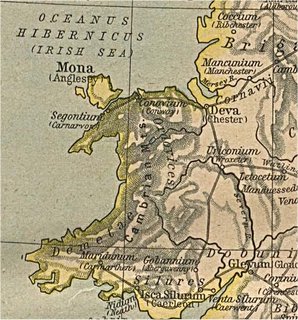
In AD 70 Agricola was given command of the Legio XX in Britannia after Vespasian became Emperor, his military campaigns mainly covering territory in western areas. Just a couple of years prior to that, Legio XIV Gemini - which had been stationed at Viroconium Cornoviorum (Wroxeter) in the lands of the Cornovii - had been pulled out and sent to Gaul after highly distinguishing itself during the Bouddican revolts. After that Legio XX, led by Agricola, probably based itself at Viroconium Cornoviorum (Wroxeter) around AD 70.

Wikimedia Commons

Viroconium Cornoviorum (Wroxeter) was a strategically useful site, handy for attempts to subdue the continuously warring tribes of what we now call Wales but it wasn’t coastal. Agricola was set to also subdue the Setantii and Brigantes of the western side of Britannia and for this a base with western sea access was very desirable.


Finding somewhere to divide the Brigantes and the Ordovices was great strategy. 

Deva-also known as Deva Victrix-( Chester) was the chosen place at the mouth of the River Dee. A sandstone cliff, close to the natural sea harbour, was the selected site for a fortress. This afforded excellent views, the river below the cliff was navigable and perfect for transportation of goods and personnel, the placing of the fortress at the bend of the river giving some protection.


It’s likely that the II Adiutrix (Auxiliary) Legion were sent to the site to begin the first wooden construction during the early AD 70s, evidence of establishment having been found in lead ingots dated for AD 74. Whether or not the site was used earlier than AD 74, for a temporary camp, I believe has yet to be established.

The fortress at Deva, covering 25 hectares, was the largest to be constructed in Britain in the AD 70s.


Sad I may be, but I’ve had a lot of fun using the Latin names for the fortresses in my current writing in progress, though remembering what was where has been quite a challenge.


I've used the fortresses at Viroconium and Deva in my current writing. Agricola being there with my characters is down to my imagination, but I'm sure that Agricola and Cerialis used Deva to best advantage.